About EFFLUENT MONITORING SYSTEM
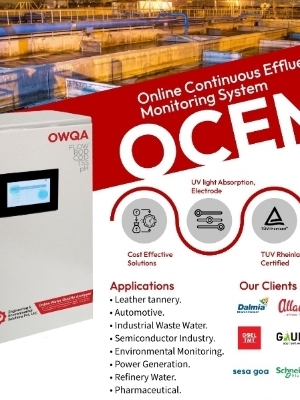
An Online Effluent Monitoring System (OEMS) is a continuous, automated system used to measure, record, and transmit key wastewater quality parameters from an Effluent Treatment Plant (ETP) or Sewage Treatment Plant (STP) to regulatory authorities like the Central Pollution Control Board (CPCB) and State Pollution Control Boards.
Real-Time Parameter MonitoringEnsure continuous regulation and optimization of your effluent streams with this system, which monitors all vital parameters-COD, BOD, pH, TSS, temperature, and flow-using advanced sensor technology. Its automated real-time process ensures accurate tracking and quick response to variations, supporting efficient process management and compliance.
Advanced Connectivity and Data ManagementTake advantage of GSM, Internet, and Ethernet connectivity, supporting Modbus RTU communication protocols. The system automatically logs and stores monitoring data locally on an SD card and remotely in the cloud, offering secure and flexible access for reporting, auditing, and regulatory requirements.
FAQ's of EFFLUENT MONITORING SYSTEM:
Q: How does the Effluent Monitoring System operate for real-time parameter measurement?
A: The Effluent Monitoring System uses advanced, robust, and replaceable electrodes to continually measure key effluent parameters such as COD, BOD, pH, TSS, temperature, and flow. The system automatically logs data, issues alerts if parameters breach set limits, and displays results on a 7-inch touchscreen LCD for easy monitoring.
Q: What are the installation requirements and mounting options for this system?
A: The system is designed for both panel and wall mounting, making it suitable for diverse industrial and treatment plant layouts. It comes with an IP65-rated enclosure for added durability, and installation is straightforward with operation possible in ambient temperatures from 0C to 50C.
Q: When does the alarm system trigger alerts, and how are these communicated?
A: The built-in alarm system generates high or low parameter alerts whenever monitored values fall outside of user-defined thresholds. These alerts are communicated via the connected interfaces (GSM/Internet/Ethernet), appearing instantly on the device display and can also be relayed to designated personnel or remote monitoring systems.
Q: Where can data from the monitoring system be accessed and stored?
A: Data is automatically stored locally on an SD card and remotely on a secure cloud server. This dual storage approach ensures that data can be accessed onsite via the LCD interface or remotely through web-based dashboards, facilitating audits, compliance checks, and operational reviews.
Q: What is the process for regular maintenance or sensor replacement?
A: Sensors are engineered for robust operation but can be easily replaced when needed, reducing downtime. Routine maintenance involves scheduled calibration and cleaning according to manufacturer guidelines to maintain measurement accuracy and system reliability.
Q: How does usage of this system benefit industrial and effluent treatment plants?
A: Implementing this system enhances regulatory compliance, ensures process stability, and mitigates environmental risks by providing real-time alerts on parameter deviations. Its automation and data management capabilities streamline reporting and strengthen operational control, resulting in improved efficiency and reduced manual labor.





 Send Inquiry



 Send Inquiry
 Send Inquiry
 Send SMS